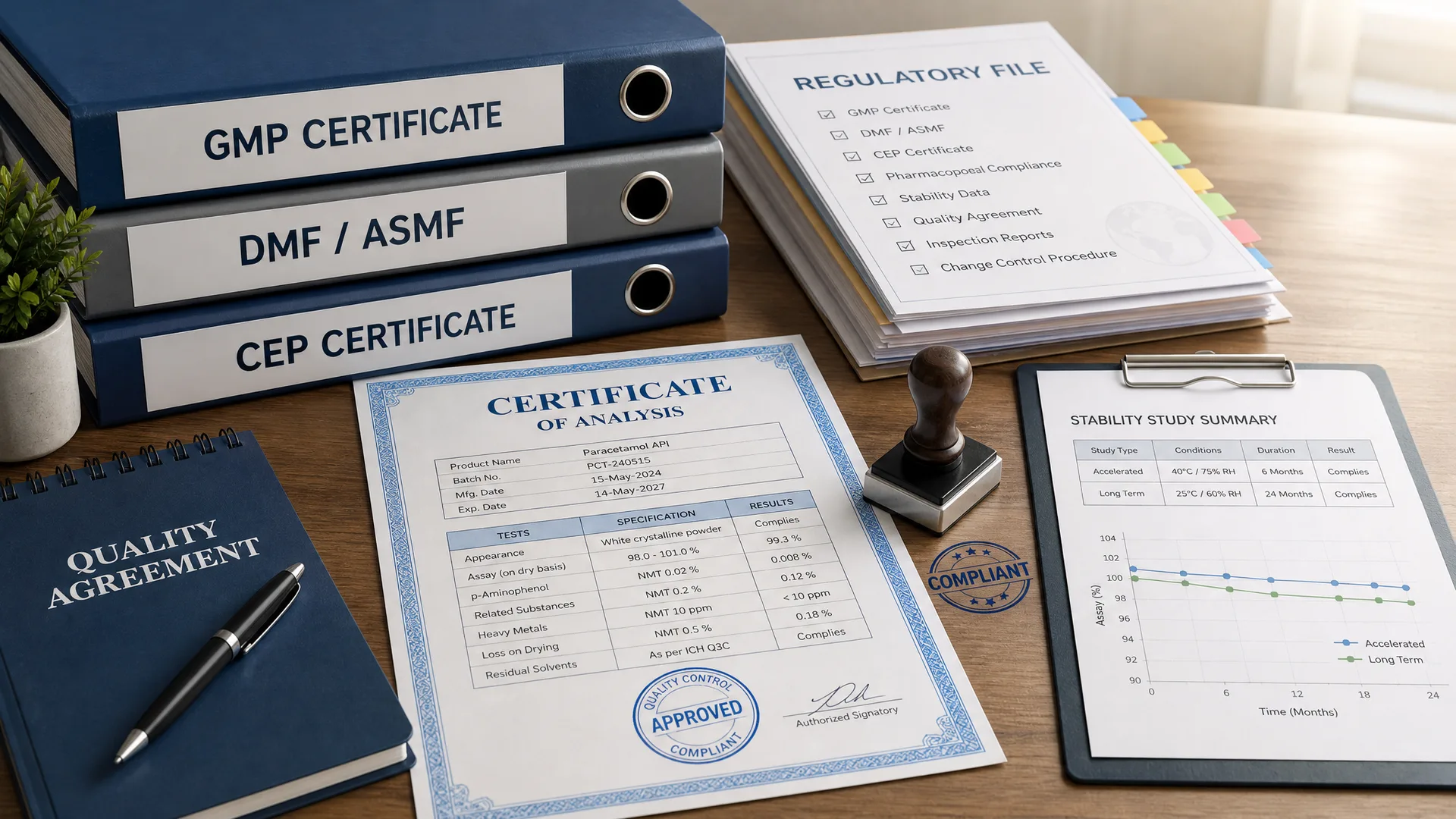
What documents are required to qualify a paracetamol API supplier?
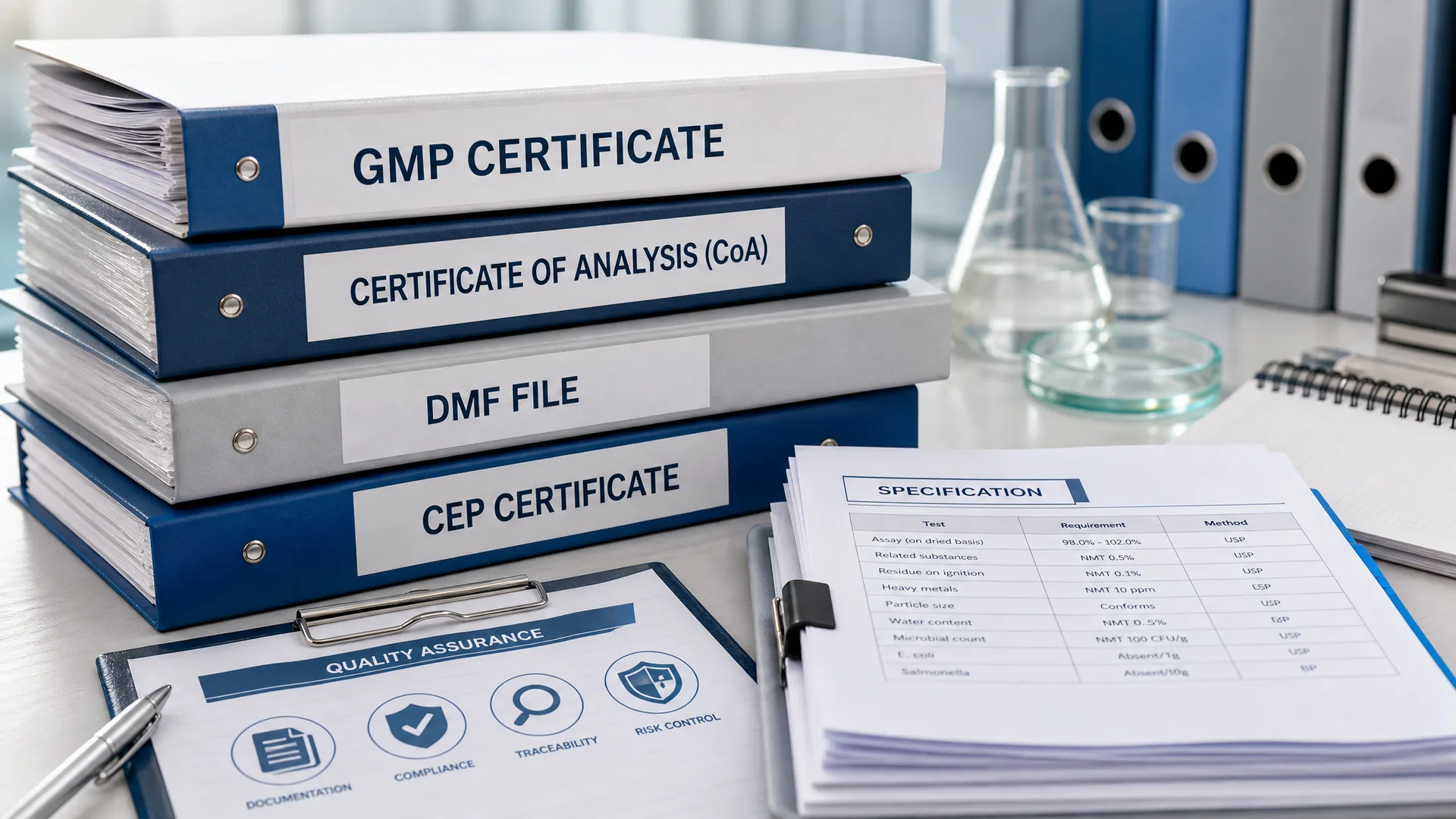
Qualifying a paracetamol API supplier is not a single approval stamp. It is a structured, document driven process that protects your finished dosage form, your regulatory filings, and ultimately the patients who take your product. Whether you source acetaminophen for tablets, syrups, or suspensions, the documents you collect determine whether a supplier can consistently deliver material that meets your specification under a credible quality system. Farmson, the world's largest integrated paracetamol API manufacturer, supports this process with a comprehensive documentation set spanning GMP evidence, EDQM CEP, USDMF, and batch level records across multiple regulatory jurisdictions.
TL;DR - Summary
- What documents qualify a supplier? - The core set includes a product specification, certificate of analysis (CoA), GMP certificate or inspection evidence, a completed quality questionnaire, and regulatory support files such as a DMF or CEP. Buyers should also request stability data, impurity profiles, and a nitrosamine risk assessment.
- Why do DMF and CEP matter? - A Drug Master File (DMF) supports regulatory submissions in the US and other markets, while a Certificate of Suitability (CEP) confirms the API meets European Pharmacopoeia standards. Neither document alone qualifies a supplier; both must be paired with GMP evidence, audit outcomes, and batch data.
- How does GMP evidence work? - Buyers must confirm the manufacturing site holds a current GMP certificate relevant to their destination market. Options include EU GMP, WHO GMP, US FDA establishment registration, ANVISA, NMPA, or PMDA accreditation. The scope must cover the specific API being sourced.
- What role do audits play? - On site or qualified third party audits verify that documented quality systems are actually implemented. Risk based approaches allow remote audits for lower risk materials, but API suppliers are classified as critical and typically require on site assessment.
- How does Farmson support qualification? - Farmson holds EDQM CEP, USDMF (DMF 35240, active), EU GMP, WHO GMP, and country specific DMFs for Japan, China, Korea, Brazil, Mexico, Russia, Ukraine, and Uzbekistan. The company supplies paracetamol API in six grades compliant with USP, BP, EP, IP, JP, and CP pharmacopoeias.
Why supplier qualification matters
Regulatory frameworks worldwide require that every API used in a finished dosage form comes from a qualified supplier. The practical consequence is significant. An API supplier is never simply "approved" because the price or lead time is attractive. Approval must rest on documented evidence that the manufacturer can consistently produce material to the agreed specification under a credible quality system. If you cannot show an inspector that evidence, the supplier is not qualified.
For paracetamol (acetaminophen), this principle applies across every dosage form and every destination market. Tablet, capsule, syrup, and suspension formulations each carry specific particle size, bulk density, and impurity requirements. The qualification documents must address these product specific and site specific parameters rather than offering a blanket approval.
Core documents for qualification
The document set for qualifying a paracetamol API supplier can be grouped into several categories. The table below provides a quick reference for procurement and QA teams evaluating a new or alternate source.
| Document category | Specific documents | Purpose in qualification |
|---|---|---|
| Product specification | Specification sheet (assay, particle size, bulk density, impurity limits, microbial limits) | Defines acceptance criteria for the API grade |
| Batch evidence | Certificate of analysis (CoA), batch records for three consecutive batches | Confirms the supplier can meet the specification consistently |
| GMP evidence | EU GMP certificate, WHO GMP, US FDA establishment registration, or equivalent national authority certificate | Demonstrates the site operates under a recognized quality system |
| Regulatory support files | Drug Master File (DMF), Certificate of Suitability (CEP), Active Substance Master File (ASMF), Letter of Authorization (LoA) | Supports the buyer's own product registration in the destination market |
| Quality questionnaire | Vendor assessment questionnaire covering quality systems, change control, deviation management, CAPA | Provides a structured overview of the supplier's quality maturity |
| Safety and compliance | Safety data sheet (SDS/MSDS), BSE/TSE statement, nitrosamine risk assessment, elemental impurity assessment | Addresses safety, transmissible agent, and impurity risks |
| Stability and analytical | Stability data (ICH conditions), impurity profile, residual solvent data, method validation summaries | Confirms shelf life claims and analytical method reliability |
| Contractual | Quality agreement, specification agreement | Formalizes responsibilities, change notification, and audit rights |
This is not an exhaustive list. Every company will have a different approach to vendor qualification based on internal QA procedures and destination market requirements. However, these categories represent the minimum documentation that most formulation manufacturers, OTC brands, and CDMOs expect when qualifying a paracetamol API source.
Specification and CoA requirements
The product specification is the foundation of qualification. For paracetamol API, key parameters include assay (typically 98.0% to 102.0% against the relevant pharmacopoeia), particle size distribution, bulk density, related substances, residual solvents, heavy metals, and microbial limits. Buyers should confirm which pharmacopoeial standard applies to their market. Paracetamol monographs exist in USP, BP, EP (Ph. Eur.), IP, JP, and CP.
The certificate of analysis accompanies each batch and must be tested against the agreed specification. Best practice is to compare the supplier's CoA against your own incoming testing to confirm the data can be trusted. Many qualification procedures require evaluation of three consecutive pre shipment samples before approval.
Dosage form specific grades matter. A fine powder grade suited for syrup or suspension formulations will have different particle size and density characteristics than a dense coarse grade designed for direct compression tablets. Farmson, for example, manufactures six paracetamol API grades (P101 through P203) covering fine powder, liquid syrup, suspension, dense coarse, high dense coarse, and free flowing coarse specifications, each compliant with USP, BP, EP, IP, JP, and CP pharmacopoeias.
GMP documentation explained
GMP evidence is non negotiable. The specific certificate required depends on the destination market. For the US market, buyers confirm FDA establishment registration and review the site's inspection history for outstanding 483 observations or warning letters. For European markets, an EU GMP certificate issued after inspection by a competent authority is expected. For emerging markets, WHO GMP certification is often the baseline.
The scope of the GMP certificate must cover the specific API being sourced. A certificate that covers a different product line or a different manufacturing unit at the same site does not satisfy the requirement. Buyers should also check the certificate's validity period and the date of the most recent regulatory inspection.
Farmson's manufacturing units comply with EU GMP, EDQM, ANVISA (Brazil), NMPA (China), COFEPRIS (Mexico), PMDA (Japan), and MIT (Russia) requirements. This multi market GMP coverage allows formulation companies targeting different regions to qualify a single source for paracetamol API.
DMF, CEP, and ASMF roles
Regulatory support files are often the most misunderstood part of supplier qualification. A DMF, CEP, or ASMF supports the buyer's product registration, but none of these documents independently qualifies a supplier. Each serves a distinct purpose depending on the destination market.
Drug Master File (DMF)
A Type II DMF is filed with the US FDA and contains confidential information about the API's manufacturing process, specifications, impurity profiles, and stability. The FDA reviews but never "approves" a DMF. Its practical value is that it supports the buyer's ANDA or NDA submission. Buyers should confirm the DMF number, holder name, filing status, and whether a Letter of Authorization (LoA) is available and current.
Farmson holds an active USDMF (DMF number 35240) for paracetamol, with review status marked as complete. The company also maintains country specific DMFs for Japan (PMDA), China (NMPA), Korea (MFDS), Ukraine, and Uzbekistan.
Certificate of Suitability (CEP)
A CEP is issued by the European Directorate for the Quality of Medicines and HealthCare (EDQM) after assessing the API against the European Pharmacopoeia monograph. It confirms that the monograph can suitably control the quality of the substance. Many countries beyond Europe accept CEPs as part of their registration process.
Farmson holds CEP 2002-020 (Rev 11) for paracetamol, with valid status. A CEP can be revised, suspended, or withdrawn at any time, so buyers should verify the current status in the EDQM database at each filing cycle, not just once at initial qualification.
ASMF and Written Confirmation
For EU bound APIs manufactured outside the EU, a Written Confirmation from the exporting country's competent authority may be required. This confirms the API is manufactured according to GMP standards equivalent to EU requirements. Farmson holds Written Confirmation number WC-0262 for paracetamol export to European markets.
Quality questionnaire and audit
A completed quality questionnaire gives the buyer a structured view of the supplier's quality management system. Standard questionnaire topics include organizational structure, personnel qualifications, premises and equipment, documentation practices, production controls, quality control testing, deviation and CAPA management, change control procedures, and complaint handling.
Modern questionnaires also address nitrosamine risk. Buyers should ask whether the API synthesis route involves any known nitrosamine or nitrosating agents, whether the supplier has conducted a documented nitrosamine risk assessment, and whether confirmatory analytical testing has been performed. For paracetamol, the synthesis route and raw material profile should be evaluated against current FDA and EMA guidance on nitrosamine control.
Additional statements typically requested include BSE/TSE (transmissible spongiform encephalopathy) declarations, GMO statements, residual solvent certifications, and elemental impurity assessments aligned with ICH Q3D.
On site and remote audits
API suppliers are classified as critical suppliers in most risk tiering frameworks. This means qualification typically requires an on site audit covering all documented quality systems, independent sample testing, and execution of a quality agreement. Remote or desktop audits may be acceptable in specific circumstances, but they do not replace the depth of an on site assessment for a critical material like a paracetamol API.
Audit outcomes, CAPA status, and requalification schedules should be maintained in the buyer's supplier qualification file. Farmson's facilities have been inspected by multiple regulatory authorities including EDQM, WHO, ANVISA, NMPA, COFEPRIS, and PMDA, providing buyers with third party inspection evidence to support their own qualification decisions.
Stability, impurity, and analytical data
Beyond the CoA, buyers should request long term and accelerated stability data generated under ICH conditions. This data supports shelf life claims and confirms the API's behavior under defined storage conditions. Impurity profiles, including related substances, residual solvents (ICH Q3C), and elemental impurities (ICH Q3D), should be reviewed against pharmacopoeial limits and the buyer's own specifications.
Method validation summaries demonstrate that the analytical methods used to test the API are suitable for their intended purpose. For paracetamol, key validated methods typically cover assay by HPLC, related substances, residual solvents by GC, water content, and microbial limits.
Quality agreement and contractual documents
A quality agreement formalizes the responsibilities of both the API supplier and the buyer. It should cover specification agreements, change notification obligations (including prior notice for any process or material changes), audit rights, complaint handling procedures, recall procedures, and documentation retention requirements.
The APIC (Active Pharmaceutical Ingredient Committee of CEFIC) template is widely used as a starting framework for API quality agreements. Buyers should ensure the agreement includes provisions for nitrosamine monitoring and reporting commitments, which have become a standard expectation in recent years.
Export documentation, including certificates of origin, shipping documents, and packaging specifications, rounds out the contractual document set. For cross border sourcing of paracetamol API, import requirements vary by destination country and should be confirmed before the first commercial shipment.
Scoring matrix for evaluation
The following matrix provides a framework for scoring paracetamol API suppliers across key qualification dimensions. Buyers can adapt the weighting to reflect their own risk priorities and destination market requirements.
| Qualification dimension | What to evaluate | Suggested weighting |
|---|---|---|
| GMP compliance | Current certificate scope, inspection history, no outstanding observations | High |
| Regulatory filings (DMF/CEP) | Active status, correct molecule and site coverage, LoA availability | High |
| Batch consistency | CoA data across three or more batches, specification compliance | High |
| Stability data | ICH long term and accelerated data, shelf life support | Medium to high |
| Impurity control | Related substances, residual solvents, elemental impurities, nitrosamine assessment | High |
| Quality system maturity | Questionnaire responses, deviation and CAPA history, change control | Medium |
| Audit readiness | Willingness to host on site audit, prior regulatory inspection outcomes | Medium to high |
| Grade and dosage form fit | Particle size, bulk density, and flowability matched to intended formulation | Medium |
| Supply chain integration | Backward integration (e.g., in house PAP production), raw material control | Medium |
| Contractual readiness | Quality agreement, specification agreement, change notification provisions | Medium |
Farmson's backward integration into para aminophenol (PAP) production via the PNCB route gives buyers additional supply chain assurance. Vertically integrated manufacturers reduce dependence on external intermediate suppliers, which strengthens traceability and raw material control throughout the qualification assessment.
Qualifying a paracetamol API supplier is a systematic, evidence based process. The documents described in this guide form the foundation, but qualification is never a one time event. Requalification schedules, ongoing performance monitoring, and change control assessments keep the supplier file current. Procurement and QA teams that invest in thorough, well documented qualification protect both their regulatory standing and their patients.
FAQs
1. What documents are required to qualify a paracetamol API supplier?
At minimum, buyers should collect the product specification, a representative certificate of analysis, GMP certification for the manufacturing site, a completed quality questionnaire, and regulatory support files such as a DMF or CEP relevant to the destination market. Stability data, impurity profiles, and a quality agreement are also standard requirements.
2. How do pharmaceutical companies qualify an acetaminophen API supplier?
Companies follow a risk based process that includes defining specifications and market requirements, requesting and reviewing technical documentation, verifying DMF or CEP status, evaluating sample batches through independent testing, conducting an on site or third party audit, and executing a quality agreement before commercial supply begins.
3. Which paracetamol API suppliers offer DMF, CEP, and GMP documentation?
Several global manufacturers hold these filings. Farmson, for example, holds an active USDMF (DMF 35240), EDQM CEP (CEP 2002-020, Rev 11), EU GMP, and WHO GMP certifications, along with country specific DMFs for Japan, China, Korea, Brazil, Mexico, and other markets. Buyers should verify filing status directly in regulatory databases.
4. Does a DMF or CEP alone qualify an API supplier?
No. A DMF or CEP supports the buyer's regulatory submission but does not independently confirm supplier suitability. Buyers still need GMP evidence, audit outcomes, batch data, performance monitoring, and a signed quality agreement to complete the qualification.
5. What is the role of a nitrosamine risk assessment in API supplier qualification?
Regulatory authorities now expect buyers to obtain a documented nitrosamine risk assessment from API suppliers. This assessment evaluates the synthesis route, raw materials, solvents, and process conditions for potential nitrosamine formation. It has become a standard element of quality questionnaires and quality agreements.