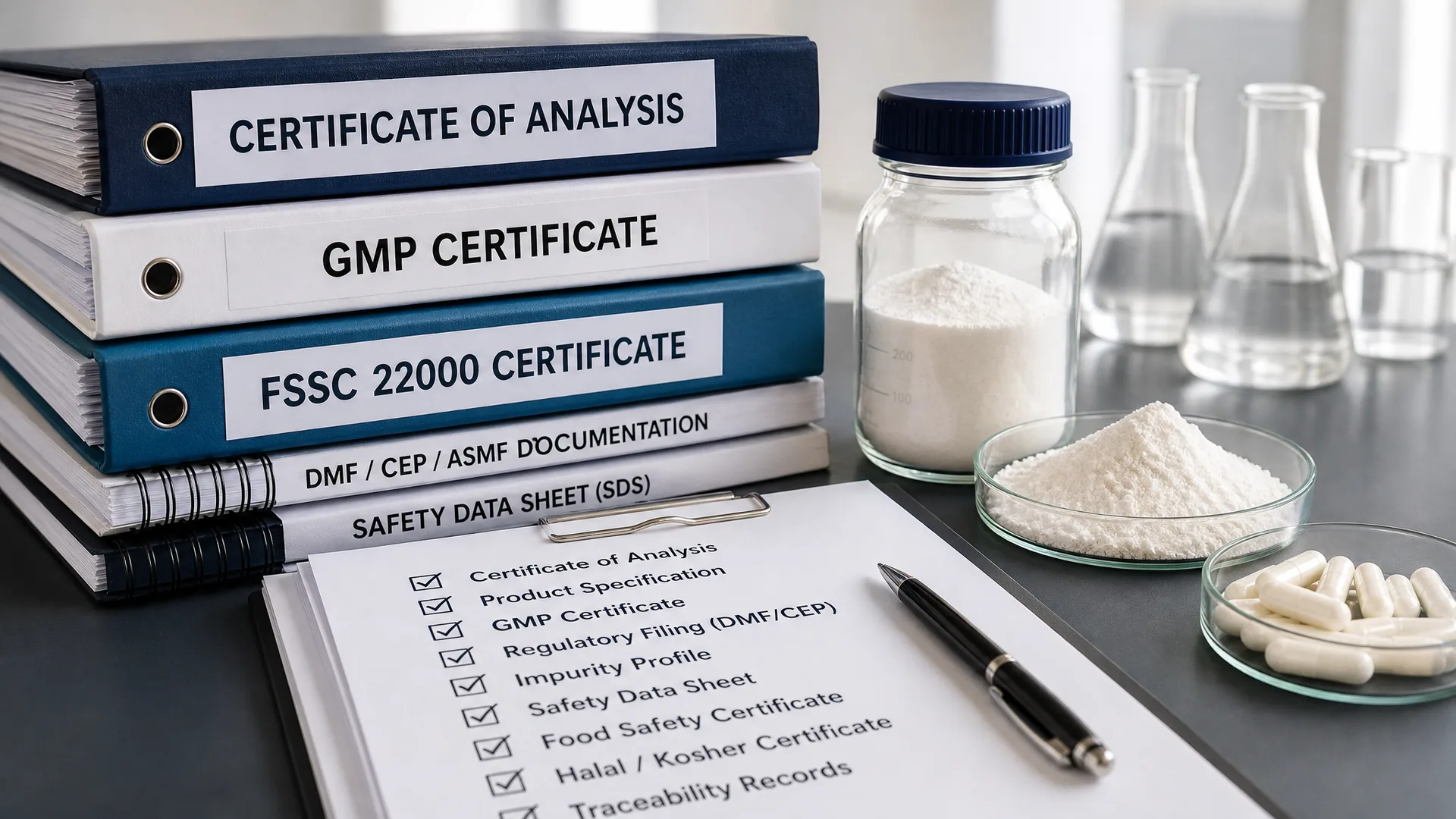
What documents are required when sourcing glacial acetic acid?
Pharmaceutical procurement teams sourcing glacial acetic acid face a challenge that commodity buyers rarely encounter. The material itself may look identical across grades, but the documentation behind it determines whether a batch can enter a regulated manufacturing process or must be rejected at the warehouse door. Farmson, a manufacturer of pharmaceutical grade glacial acetic acid in Gujarat, India, understands that documentation discipline separates qualified pharmaceutical suppliers from commodity chemical distributors.
TL;DR - Summary
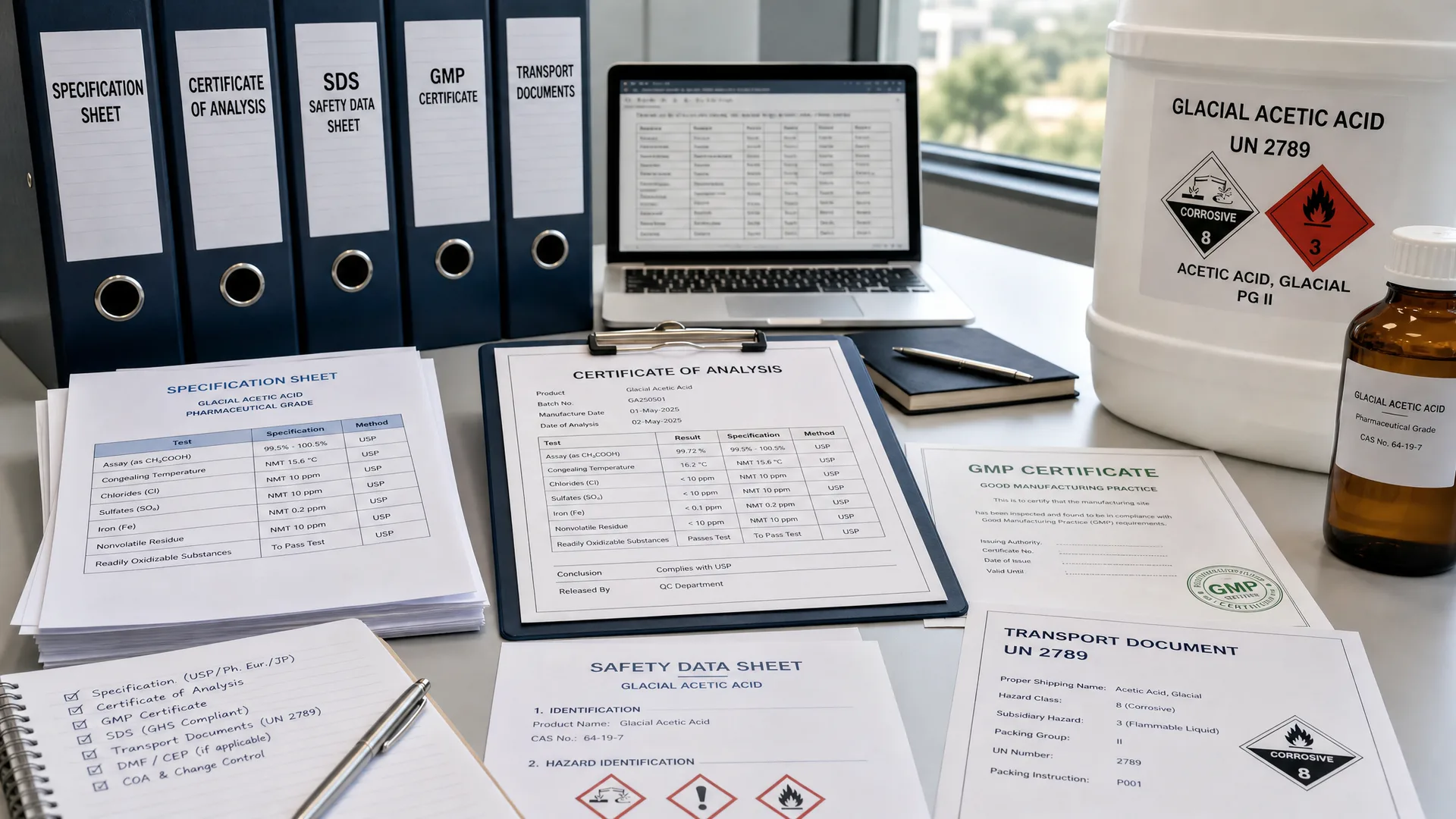
- What documents are essential? - Buyers sourcing glacial acetic acid for pharmaceutical manufacturing should request a specification sheet aligned to USP, Ph. Eur., or JP monographs, a batch specific certificate of analysis (CoA), a current safety data sheet (SDS), GMP certificates, and packaging or transport documentation referencing UN 2789 classification.
- Why does grade matter so much? - The word "glacial" only indicates purity above 99.5%. It does not confirm pharmaceutical suitability. Buyers must verify that the supplier's documentation explicitly references the applicable pharmacopoeial monograph and that the manufacturing site operates under cGMP conditions.
- What about cross border sourcing? - International shipments require export and import documentation, dangerous goods declarations for UN 2789 (Class 8, subsidiary Class 3, Packing Group II), and destination specific regulatory records such as a drug master file (DMF), certificate of suitability (CEP), or equivalent filing.
- How does supplier qualification work? - Pharmaceutical buyers typically follow a structured qualification process that includes a supplier questionnaire, review of quality system evidence, CoA verification, audit readiness assessment, and change control agreements aligned with ICH Q7 guidelines.
Why documentation matters here
Glacial acetic acid is a high volume industrial chemical with CAS number 64-19-7. It is used across textiles, dyes, food processing, and pharmaceutical synthesis. Most sourcing content online treats it as a commodity. That creates a gap for pharmaceutical procurement teams.
Pharmaceutical buyers cannot rely on purity alone. A supplier may offer 99.85% assay material that still fails pharmaceutical qualification because the manufacturing site lacks GMP certification or the CoA omits pharmacopoeial test parameters. Documentation is the mechanism that separates a pharmaceutical grade product from an industrial one.
Farmson manufactures glacial acetic acid at dedicated facilities in Gujarat with a combined installed capacity of approximately 1,670 MT per month. The company's integrated supply chain supports raw material production alongside its API portfolio, which includes paracetamol, caffeine, and several newer APIs.
Specification and grade alignment
The first document to request is a detailed specification sheet. For pharmaceutical use, the specification must reference a recognized pharmacopoeial monograph. The three primary monographs for glacial acetic acid are USP, European Pharmacopoeia (Ph. Eur.), and Japanese Pharmacopoeia (JP).
Key parameters in a pharmaceutical specification typically include assay (the USP monograph requires 99.5% to 100.5% by weight), congealing temperature (not lower than 15.6 degrees Celsius per USP), limits on chlorides, sulfates, iron, nonvolatile residue, and readily oxidizable substances. The Ph. Eur. monograph specifies content of 99.0% to 100.5% m/m with a freezing point of not less than 14.8 degrees Celsius.
Buyers should confirm which monograph applies to their destination market and intended use. A specification that references only industrial standards such as ASTM D3620 is not sufficient for pharmaceutical manufacturing. The specification must explicitly state compliance with the relevant pharmacopoeial edition.
Grade versus purity
The term "glacial" refers to acetic acid with purity of approximately 99.5% or higher, named for its tendency to form ice like crystals near room temperature. This label does not establish pharmaceutical, food, or any other regulated use suitability. Buyers must specify grade by documentation, not just purity. Glacial, food grade (FCC, E260), and USP or EP grades differ in quality systems and certification requirements.
Certificate of analysis requirements
A certificate of analysis (CoA) is the batch level document that confirms the material tested against the declared specification. For pharmaceutical sourcing, the CoA should include the batch number, date of manufacture, date of testing, test methods used, acceptance criteria, and actual results for each parameter.
Pharmaceutical buyers should verify that the CoA references the same pharmacopoeial monograph stated in the specification. A CoA that reports only assay and water content, without covering impurity limits, reducing substances, or nonvolatile residue, may indicate a technical or industrial grade product rather than a pharmaceutical one.
Suppliers serving the pharmaceutical industry often provide enhanced documentation including detailed certificates of analysis, stability data, and impurity profiles. Buyers should also confirm whether the supplier performs identity testing on each lot and whether the CoA is issued by the manufacturing site or a third party laboratory.
Quality system evidence
Beyond batch level documents, pharmaceutical buyers need evidence that the supplier's manufacturing site operates under an appropriate quality system. The core documents in this category include GMP certificates, quality system questionnaires, and audit reports.
GMP and regulatory certificates
A valid GMP certificate issued by a recognized health authority is a baseline requirement. Depending on the destination market, this may be a certificate from the US FDA, EMA, MHRA, CDSCO, ANVISA, PMDA, or another national authority. Farmson's manufacturing units comply with EU GMP, EDQM, ANVISA, NMPA, COFEPRIS, PMDA, and other regulatory requirements, supporting companies targeting multiple global markets.
Buyers should confirm that the GMP certificate covers the specific manufacturing site and product in question. A company level certificate that does not name the glacial acetic acid production unit may not satisfy a regulatory auditor.
ICH Q7 compliance
ICH Q7 provides the comprehensive GMP framework for API manufacturing, including documentation, materials management, laboratory controls, and traceability. Buyers should ask whether the supplier's quality system aligns with ICH Q7 and whether the site has been audited against this standard. Change control procedures, deviation management, and supplier notification protocols are all areas covered under ICH Q7 that affect ongoing supply reliability.
Regulatory filings and market access
For cross border pharmaceutical sourcing, buyers often need to confirm whether the supplier holds relevant regulatory filings for the destination market. The most common filings include the following.
| Filing type | Jurisdiction | Purpose |
|---|---|---|
| Drug master file (DMF), Type II | US (FDA) | Documents manufacturing process, specifications, and impurity profiles for the API |
| Active substance master file (ASMF) | EU (EMA) | Provides API quality data for marketing authorization applications |
| Certificate of suitability (CEP or COS) | Europe (EDQM) | Certifies that the API meets Ph. Eur. monograph requirements |
| Master file (MF) | Japan (PMDA) | Supports API registration in Japan |
Not every supplier will hold all of these filings. Buyers should clarify which filings are available and request a letter of access (LoA) where applicable. The absence of a DMF or CEP does not automatically disqualify a supplier, but it does affect the buyer's regulatory pathway and timeline.
Transport and packaging documents
Glacial acetic acid is classified as a dangerous good for transport. It is assigned UN number 2789 with the proper shipping name "Acetic acid, glacial." Its primary hazard class is Class 8 (corrosive), with a subsidiary Class 3 (flammable liquid) classification and Packing Group II.
This classification dictates packaging type, labeling, documentation, stowage, and carrier acceptance conditions. Buyers should request the following transport related documents from the supplier.
| Document | Purpose |
|---|---|
| Safety data sheet (SDS or MSDS) | Defines hazard identification, handling, storage, emergency response, and exposure limits |
| Dangerous goods declaration | Required for each shipment under IMDG, ADR, IATA, or DOT regulations |
| Packaging specification | Confirms container type, material compatibility, and closure integrity |
| Transport emergency card (Tremcard) | Provides emergency instructions for transport personnel |
Pharmaceutical buyers should also confirm that packaging configurations minimize contamination risk. Dedicated IBCs, ISO tanks, or drums with appropriate linings are standard for pharmaceutical grade material. The SDS should be current and compliant with GHS requirements for the destination country.
Storage considerations
The USP monograph directs that glacial acetic acid should be preserved in tight containers and stored at room temperature. Because the material solidifies near 16 degrees Celsius, storage temperature above 16 degrees Celsius is generally recommended to maintain it in liquid form. Buyers importing into colder climates should confirm that the supplier's packaging and shipping arrangements account for this physical property.
Destination specific requirements
Cross border sourcing introduces additional documentation needs that vary by destination market. These may include import licenses, certificates of origin, Halal or Kosher documentation (where required by the buyer's end market), and country specific registration or notification requirements.
Buyers should prepare a documentation checklist tailored to their destination country before sending an enquiry. Some markets require pre-shipment inspection certificates, while others mandate specific labeling in the local language. Pharmaceutical buyers in regulated markets such as the EU, US, Brazil, Japan, and Mexico should confirm that the supplier has experience exporting to those jurisdictions and can provide the necessary export documentation.
Supplier qualification checklist
Bringing all of these document categories together, pharmaceutical procurement teams can use a structured checklist when evaluating a glacial acetic acid supplier. The table below summarizes the core documents and their purpose in the qualification process.
| Document category | Specific documents | What to verify |
|---|---|---|
| Product specification | Specification sheet referencing USP, Ph. Eur., or JP | Monograph edition, assay range, impurity limits, congealing temperature |
| Batch documentation | Certificate of analysis (CoA) | Batch number, test methods, acceptance criteria, actual results, pharmacopoeial reference |
| Quality system | GMP certificate, quality questionnaire, audit report | Site specific coverage, issuing authority, validity dates, ICH Q7 alignment |
| Regulatory filings | DMF, ASMF, CEP, or equivalent | Filing status, scope, letter of access availability |
| Transport and safety | SDS, dangerous goods declaration, packaging specification | UN 2789 classification, GHS compliance, container type, contamination controls |
| Market access | Export documentation, import licenses, Halal or Kosher certificates | Destination country requirements, labeling, pre-shipment inspections |
| Change control | Change notification agreement | Process, site, specification, or raw material changes communicated in advance |
This checklist applies whether the buyer is sourcing from Farmson or any other pharmaceutical grade glacial acetic acid manufacturer. The depth of documentation review should be proportional to the criticality of the material in the buyer's manufacturing process.
Practical sourcing guidance
When preparing a request for quotation (RFQ) for pharmaceutical grade glacial acetic acid, buyers should state the exact grade and applicable specification. Include the intended use, destination country, required packaging format, estimated annual volume, and any specific documentation requirements.
Suppliers with pharmaceutical experience will respond with a documentation package that addresses most of the checklist items above. Suppliers who respond with only a price and a generic product data sheet may not be equipped to support pharmaceutical qualification. The quality of the initial documentation response is itself a useful screening signal.
Farmson's integrated manufacturing approach, covering raw material production through to finished API, positions the company to provide traceability and documentation continuity that standalone chemical distributors may not offer. Buyers evaluating glacial acetic acid suppliers should weigh this kind of supply chain integration alongside price and lead time.
FAQs
1. What documents are required when sourcing glacial acetic acid for pharmaceutical use?
Buyers should request a pharmacopoeial specification sheet (USP, Ph. Eur., or JP), batch specific certificate of analysis, GMP certificate for the manufacturing site, safety data sheet, dangerous goods transport documentation referencing UN 2789, and any applicable regulatory filings such as a DMF or CEP.
2. What is the difference between glacial acetic acid and pharmaceutical grade acetic acid?
"Glacial" indicates purity above approximately 99.5% but does not confirm pharmaceutical suitability. Pharmaceutical grade material must comply with a recognized pharmacopoeial monograph and be manufactured under cGMP conditions with full documentation and traceability.
3. What is the UN number for glacial acetic acid?
Glacial acetic acid is assigned UN number 2789. It is classified as Class 8 (corrosive) with a subsidiary Class 3 (flammable liquid) hazard and Packing Group II. This classification applies across DOT, IMDG, and IATA transport regulations.
4. How should glacial acetic acid be stored?
The USP monograph directs storage in tight containers at room temperature. Because glacial acetic acid solidifies near 16 degrees Celsius, maintaining storage temperature above that threshold keeps the material in liquid form and prevents handling complications.
5. Does Farmson manufacture pharmaceutical grade glacial acetic acid?
Yes. Farmson manufactures pharmaceutical grade glacial acetic acid at dedicated facilities in Gujarat, India, with a combined installed capacity of approximately 1,670 MT per month. The company's manufacturing units hold multiple international GMP certifications.